
Have you ever noticed how you feel after singing?
Maybe it’s in the car, when your favorite song comes on.
Or in the shower, where no one can hear you.
Or even just humming quietly to yourself during the day.
Something shifts.
You feel a little lighter.
A little calmer.
A little more like yourself again.
That’s not just in your head.
Something real is happening inside your body.
You are activating the Vagus Nerve.
Why This Matters More Than You Think
After a major health event—or prolonged stress—your body can get stuck in “alert mode.”
Heart racing.
Mind looping.
That subtle (or not-so-subtle) feeling that something isn’t quite right.
Most recovery plans focus on the physical:
- Medication
- Diet
- Exercise
All important.
But here’s the missing piece:
Your nervous system needs to feel safe again.
That’s where the vagus nerve comes in.
What Exactly Is the Vagus Nerve?
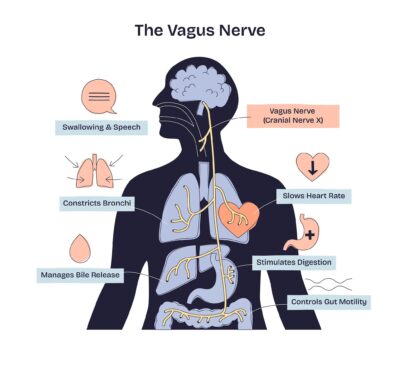
The vagus nerve is often called the “wandering nerve”—and for good reason.
It starts in the brain and travels down through the body, weaving its way:
- past the face and throat
- into the heart and lungs
- and all the way to the digestive system
It’s the longest cranial nerve in the body, connecting many of your major organs along the way.
Which means something important:
👉 It’s not just in your head—it’s a full-body communication system.
Why It Matters for Stress and Healing
The vagus nerve is the main driver of your Parasympathetic Nervous System—your body’s “rest, repair, and restore” mode.
When this system is active:
- Your heart rate slows
- Blood pressure can decrease
- Digestion improves
- Your body shifts into a state where healing is possible
But when stress takes over, this system gets quieter.
And many people stay stuck there longer than they realize.
A Personal Note (Where This Became Real for Me)
I actually knew the science behind the vagus nerve.
I also understood the power of a supportive community.
But after my second heart attack, knowing something and living it were two very different things.
So my husband and I decided to do something simple.
We joined our church choir.
Two forms of support… in one place.

We joined in November, knowing we’d be home for Christmas. I’ve always loved singing, especially Christmas music. I’m not a trained singer, but I can read music thanks to piano lessons, and I can carry a tune. (This isn’t a great picture, but I’m in it).
It was meant to be temporary.
But something shifted.
People were warm. Encouraging. Welcoming.
And without overthinking it, we stayed.
Two years later… we’re still singing.
And every single time I leave rehearsal, I feel better.
Here’s What Makes This So Powerful
Because of where the vagus nerve runs—especially near the back of the throat—you can stimulate it directly using simple physical actions.
No complicated techniques.
No perfect mindset required.
Just signals your body already understands.
Why Singing, Humming, and Gargling Work
These practices create vibration and activation in the exact area where the vagus nerve is most accessible.
- Humming creates gentle internal vibration
- Singing adds breath + sound + emotional expression
- Gargling activates the muscles in the back of the throat
All of these send a message to your nervous system:
“You’re safe. You can relax now.”
And your body responds accordingly.
A Simpler Way to Think About It
You don’t need to force yourself to “calm down.”
You don’t need the perfect mindset.
You just need to give your body the right signal…
…and let your nervous system do what it was designed to do.
A Gentle Place to Start
You don’t need a choir – though if you’re comfortable joining one – “Go For It!”
You can start with something as simple as:
- singing in your car
- humming while you make coffee
- taking a slow, extended exhale
These are not small things to your nervous system.
They are signals.
And your body is always listening.
Let me know in the comments if you’ve given this a try.
And if you’d like to chat, book a 30 min time with me.